
Practical Information
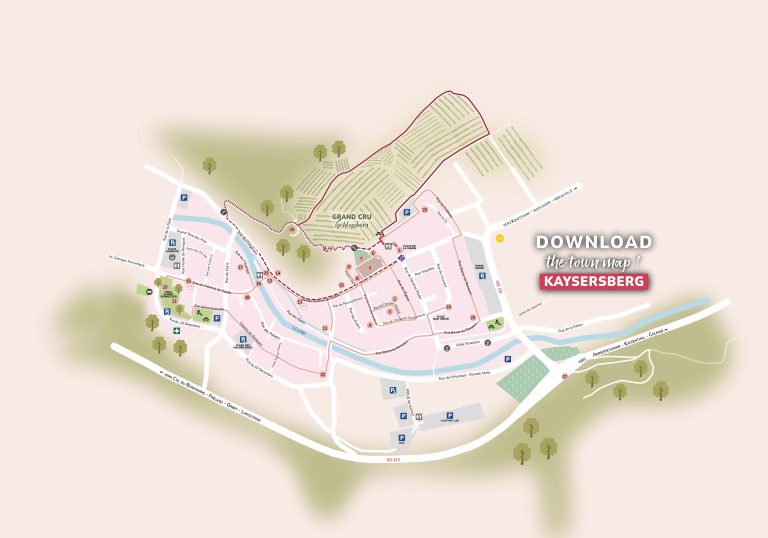
- Complete historic tour (27 stops): 1.5 to 2 hours at a leisurely pace.
- Hike up to Kaysersberg Castle: allow an additional hour (round trip).
- A map of Kaysersberg is available free of charge at our visitor centers or for download.
An imperial city in the heart of Alsace
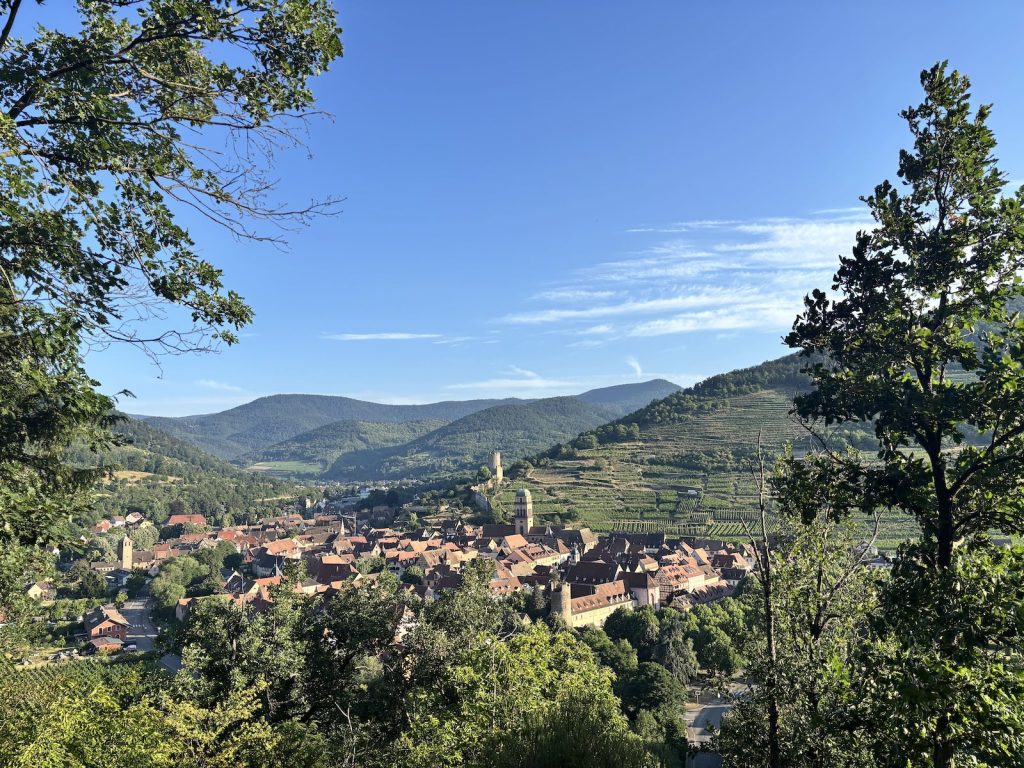
The history of Kaysersberg dates back well before the Middle Ages, but it was in the 13th century that the town truly began to flourish. Its very name hints at its destiny: in German, Kaysersberg means “the Emperor’s Mountain” (Kaiser = Emperor, Berg = mountain), an etymology directly linked to the castle that overlooks the town from the heights of the Schlossberg.
Kaysersberg Castle, which overlooks the town, was built by Emperor Frederick II of the Holy Roman Empire. The town’s name derives from this castle.
In 1293, Kaysersberg was granted the status of a free imperial city, a prestigious title that conferred considerable autonomy and allowed it to develop a rich architectural heritage. Over the centuries, local burghers and patricians competed in elegance to build remarkable residences. Today, the 15th-, 16th-, and 17th-century facades still bear witness to this past prosperity, forming one of the best-preserved medieval ensembles in Alsace.
27 buildings to explore
1. Town Hall
The tour begins at City Hall. From the street, you can admire this U-shaped building, constructed in 1604. Flanked on the left by a stair tower and adorned with a carved, vaulted Renaissance oriel window, the building features a beautiful coffered ceiling and exceptional columned doors, inlaid with precious woods and decorated with allegorical figures that serve as a reminder that the building was once used for the administration of justice.
2. Former Manor of Etienne de Bavière
On your right is the manor house of Etienne of Bavaria and his wife Claire de Hunawihr. Built in the 14th century and remodeled several times, the building housed the town’s hospital until the 19th century, then served as the gendarmerie in the 20th century. Note the mullioned windows on the first floor toward the center of the building. Further on is a very interesting crenellated porch decorated with the coats of arms of the couple who built it. Like many symbols of power—which were then in the hands of the nobility and the Church—the coats of arms on the lintels were hammered down during the French Revolution.
This imposing residence is built of stone, and only the powerful—the nobility and the clergy—could afford to have this type of home constructed. Others, particularly artisans and merchants, built half-timbered houses made of wood and cob.
3. Buchele House
Across from the manor house, at No. 7 Rue de l’Ancien Hôpital, stands the Buchelé House. Dendrochronological analyses date it to 1458. The half-timbered structure is infilled with bricks, some of which are original.
Of particular note is the half-timbering known in the Manx language as “Homme,” named for its symbolic representation of a man with outstretched arms and legs.
You’ll see this symbol very frequently on the town’s houses.
The windows have been replaced at various times, but on the other side of the house on the first floor, between the two current windows—although they’re bricked up—you can see two medieval windows with wooden mullions.
4. Renaissance House
Built in 1594, this elegant Renaissance house belonged to Johann Vollrath, who held the city’s highest offices. On one window, a piece of advice dating back more than 400 years still urges wisdom: “Be thrifty in your youth, for poverty afflicts old age.” Right next door stood the commandery of the Teutonic Knights, who were based in Kaysersberg for nearly five centuries.
5. Sainte-Croix Church
Built beginning in the 13th century, the Church of the Holy Cross in Kaysersberg harmoniously blends Romanesque and Gothic architecture.
As soon as you enter, your gaze is drawn to its impressive monumental Calvary, before you discover one of its greatest treasures: the Renaissance altarpiece created in 1518 by Jean Bongart. Comprising fourteen carved panels depicting the Passion of Christ, it is considered one of the masterpieces of Alsatian religious art.
As you explore the church, be sure to take the time to admire its sole surviving medieval stained-glass window, its historic organ from 1720, and the many works of art that bear witness to nearly eight centuries of history.
6. Saint-Michel Chapel and its Ossuary
The Saint Michel Chapel and the ossuary located beneath it date from 1463 and are built against the surrounding wall. The cross-ribbed vault of the ossuary and the ribbed vault of the chapel are decorated with early 16th-century paintings. The ossuary is not accessible, but the paintings can be glimpsed through the upper parts of the doors.
The ossuary houses the remains from the old cemetery, which was moved outside the city walls in 1511.
An inscription in German reads: “It is only fair; here the master rests beside his servant.” The upper and lower chapels were used for services for the dead.
7. Military Cemetery
This memorial honors the soldiers who fell during the Liberation of the Weiss Valley in 1944.
It also houses several cultural treasures, including the Mont des Oliviers (1501) and the famous “plague cross,” which recalls a remarkable legend: After refusing to allow a procession from a neighboring village—which had come to implore an end to an epidemic—to pass through, the residents of Kaysersberg saw the disease spread to their town… before it disappeared once the procession finally made its way through the town.
8. Fountain of Emperor Constantine
In front of the courtyard of Sainte Croix Church, atop the fountain, stands a yellow sandstone statue of Emperor Constantine.
Like the altarpiece inside the church, it is the work of Jean Bongart. It has adorned the fountain since 1521. It is worth noting that Constantine was the son of Saint Helena, who discovered “the True Cross” and whose modern statue adorns the church’s façade.
Roman Emperor from 306 to 337, Constantine granted freedom of worship to all, including Christians, thereby paving the way for the establishment of a Christian Empire.
During the Revolution, the statue was replaced by a tricolor pyramid, while Kaysersberg was renamed “Mont Libre.”
Turn your back on the church, walk about ten meters, and turn right onto Impasse du Père Staub.
9.Maison Bohn
At No. 49 Impasse du Père Staub, the Bohn House, built in 1601, is particularly ornate, with its carved corner posts and spandrels. The sandstone cornerstone on the ground floor bears a rebus inscription asking for the protection of God and the Virgin Mary against destruction, water, war, the plague, and fire.
This house served as the town’s first school.
Across from the Bohn House, you can also admire a magnificent house dating from 1576. At the end of the cul-de-sac, be sure to see what is believed to be the original entrance to the castle. Pause the audio guide and head to house No. 6 on Rue du Général de Gaulle.
To do so, walk down the cul-de-sac, turn right, and continue to the end of the square.
10. Loewert House
This elegant Renaissance mansion has stood the test of time, preserving its beautiful original features.
Look up to admire the 18th-century painting of the Virgin and Child, which still watches over the façade.
11. Volz House and its Well
The Voltz House can be seen at the far end of the vast courtyard. It dates back to 1618.
Built by Mathias Huffel, a prominent citizen of the town, and his wife Elisabeth Birckel, this large Renaissance house features trompe-l’œil murals on the second floor, as well as a monumental wine press on the ground floor.
One of Alsace’s most famous wells stands against the facade. An inscription in German reads something like this: “If you gulp down water, it will chill your stomach. Drink the fine old wine in moderation, I advise you, and leave my water alone.”
The coats of arms of the two families are visible at the top of the well: Huffel on the left and Birckel on the right.
Pause the audio guide and head back to the square. Twenty meters to your left are the so-called “twin houses.” We recommend walking along the sidewalk across the street to get a better view of these imposing buildings.
12. The Twin Houses
Built in 1521 by a wealthy silver mine owner, these two magnificent Renaissance mansions are among the most photographed in Kaysersberg.
One houses the Historical Museum (open in July and August), which displays treasures of local history, while the other features an imposing Renaissance fireplace, one of the oldest in Alsace. Next door, the former imperial mill and its canal serve as a reminder of the vital role water played in the town’s development.
13. Old Butcher's Shop
The former public butcher shop was rebuilt in 1616 above the Mill Canal. The side facades are almost entirely half-timbered, while the main facade—made of sandstone and visible from the small square on the right—features a scalloped gable and bears the carved coats of arms of Johann Volrhat and the town.
Butcher shops at the time were public and strictly regulated. Farmers came here to sell their products, which were sorted by category.
The adjoining slaughterhouse was located in the house on the corner between the fortified bridge and Rue des Bains.
If you’re facing the fortified bridge, turn around—you’re now standing in front of the Ohnenstetter-Herzer house.
14.Ohnenstetter-Herzer Renaissance House
The Ohnenstetter-Herzer House was built in 1492 for the blacksmith Herzer and his wife. The large window with a projecting frame bears an inscription that translates as: “Thistles and thorns prick sharply, but malicious tongues prick even more so. That is why I would rather fall into thistles than have to deal with malicious tongues.”
Acquired by the city in 1907, the house was completely restored and served as the city’s museum for 65 years.
15. Hostellerie du Pont
The Fortified Bridge, documented as such since 1514, spans the Weiss River. Built in 1600, this building has served many purposes over the years: an inn, public baths, a community hall… At the end of Rue des Forgerons, you can also explore the Porte de la Pucelle, Kaysersberg’s last remaining medieval gate.
16. Fortified Bridge
The Fortified Bridge, documented as such since 1514, spans the Weiss River and connected the Old Town with the Upper Town. Unique in Alsace, it features a small cell in the middle where residents were locked up for minor offenses and short periods of time.
It was not uncommon to spend time in this peculiar jail and become the laughingstock of the other residents. Skipping Mass, committing adultery, or eating fish on a Friday would land you straight in what was called the Narrenhäuslein, or “little house of fools.”
Notice the coat of arms at the top: on the left is the two-headed eagle of the Holy Roman Empire, and on the right is the Besace of Kaysersberg.
Pause here, cross the bridge, turn right, and head toward the Oberhof Chapel. It’s located in a courtyard on the left, 20 meters past the bridge.
17. Oberhof Chapel
Located on the left bank of the Weiss River, the Oberhof Chapel was part of the tithe court of Pairis Abbey, a Cistercian monastery in the Val d’Orbey.
Built in 1391 and expanded in 1473, it survived the vandalism of the Revolution.
The chapel is accessible but is located on private property. Please respect the site and its residents. As you enter, you’ll find a brief history of the chapel in French on your left.
The tithe court was responsible for collecting the tithe, a tax levied on those who used the abbey’s lands.
Pause the player, head back toward the bridge, then turn right until you reach No. 88 on Rue du Gal de Gaulle.
18. Offinger-Brief House
This stately artisan’s residence, featuring a small apartment and a L-shaped passageway, was built in 1594 for the cooper Paul Offinger. The owner’s initials and emblems appear several times on the house.
Surprisingly, the engraved initials are the letters B.O. Local historians have long sought to explain why there is a B instead of the P in Paul. They searched until, like true Alsatians, they realized that “Paul,” when pronounced with the local accent, sounded like “Baul.” The stonemason responsible for the mistake was clearly from the region!
Stop reading here and continue at No. 124, the birthplace of Albert Schweitzer.
19. Schweitzer Birthplace and Centre
Albert Schweitzer was born at No. 124 on January 14, 1875. A theologian, philosopher, musician, humanist, and, ultimately, a physician, Schweitzer set sail for Gabon in 1913 and built a hospital there in Lambaréné, on the banks of the Ogoué River. A recipient of the Nobel Peace Prize in 1952, despite the criticism and hardships that often plagued him, Albert Schweitzer remains one of the most influential figures and the most famous Alsatian of the 20th century.
His legacy lives on in Lambaréné, where he died in 1965, as well as in Kaysersberg through the Schweitzer Center and the square named after him.
If you’d like, you can visit the Schweitzer Center, which was renovated in 2022. Otherwise, turn left when you reach the end of the street.
20. Square Albert Schweitzer
A few meters from the bust of the “Great White Doctor,” a memorial created by Martine Lutz and donated to the town of Kaysersberg by the Espoir de Colmar Association was unveiled in 2005. These sculptures were carved from larch wood.
You can take a break from your tour and enjoy the park, or, if you prefer, continue on to the tower known as the “Porte Haute,” which is just a few steps away.
21. Porte Haute Tower
The tower known as the Porte Haute dates from the 15th century and was part of the double wall built between 1424 and 1432 during the city’s last expansion.
Its function was related to watchtower duties and the city’s defense.
Pause the audio guide and take a leisurely stroll to the next stop, the Kessler Tower. Refer to the map if necessary. Along the way, you’ll see the remains of the old moats as well as the tower known as the “Curé” Tower.
22. Kesslerturm Defensive Tower
Built in 1371 as part of the expansion of the city walls, the Kessler Tower served as a prison for many years. In February 1943, it was also the scene of a significant event during World War II: young Alsatians who had defied the Nazi occupiers were imprisoned there before being deported or forcibly conscripted into the Wehrmacht.
23. La Poudre Tower, also known as L'Hôpital Tower
The so-called “Hôpital” Tower. Built in the 15th century, this tower served as a powder magazine. It is one of the five remaining towers out of the six that once stood along the city walls.
24. Former Franciscan Convent
The Franciscan church, rebuilt in 1783, was part of the Franciscan convent that had been located here since 1483. The buildings are now home to a nursing home. Inside, the cloister of the former convent still stands.
25. Junker Hansen Tower or the Witches' Tower
La Tour dite de Junker Hans était connue sous le nom de Tour des Voleurs eu 18e siècle et de Tour des Sorcières au 19e siècle. Elle date du 15e siècle et servit elle aussi de prison.
26. Castle Ruins
Located at an elevation of 295 meters and towering 50 meters above the town, Kaysersberg Castle was rebuilt beginning in 1217. A curtain wall dating from 1266–68 surrounds the keep in a beak-shaped layout. The 13th-century residential wing was built against this outer wall. In the 15th century, the castle’s defenses were modernized and adapted for the use of firearms.
The keep, one of only two circular keeps in Alsace, has walls 4.42 m thick and a diameter of 11 m. The castle primarily served a military function of both passive and active defense. Below, toward the town, a spacious bailey could serve as a refuge for residents in case of an alert. Ruined by the Swedes in 1632 during the Thirty Years’ War, the fortification passed into private hands during the Revolution. Designated a Historic Monument in 1841, the ruins suffered damage during the fighting in 1944.
Excavated by archaeologist Jacky Koch and restored in 1995–96 under the direction of the Historic Monuments Authority, the castle once again looks magnificent.
27. Saint-Wolfgang Chapel
Located on a rock overlooking the town to the south, the Saint-Wolgang Chapel and the adjoining leper colony were built in 1418 and rebuilt in 1488 and 1519. These buildings stood well outside the town, very close to the cemetery they overlooked, to avoid any contact with the sick.
The chapel and the leper colony are not open to visitors.