
Ammerschwihr is not one of those Alsatian villages that seek to attract attention at all costs. Nestled between Colmar and Kaysersberg, it reveals itself discreetly, in harmony with the vineyards that surround it. Yet, on the hillsides overlooking the village lies one of Alsace’s most unique terroirs: the Kaefferkopf.
Here, nothing happened overnight. It took nearly 75 years of efforts, debates, and perseverance before this vineyard finally obtained Grand Cru status in 2007, a belated recognition for a terroir whose history dates back to the Middle Ages.
Even today, the Kaefferkopf retains its distinctive character. Its rolling landscapes, the exceptional diversity of its soils, and the passion of the winemakers who cultivate it make it much more than just a Grand Cru: it is a living place, where each plot tells a different story.
A name, a story, and a lot of patience
The name is worth a closer look. Kaefferkopf literally means “beetle’s head” in Alsatian, a reference to the silhouette of the two hills that form the heart of the vineyard, as seen from the sky. Not very glamorous at first glance. But perhaps it is this disconnect between the name and the reality of the wine that says something about the Alsatian character: understated in appearance, generous in the glass.
The first written record dates back to 1328, in the land registry of Pairis Abbey, under the name “Zem Kefersberg.” Nearly 700 years of viticulture on the same plots. And yet, official recognition did not come until 2007.
In 1932, the winegrowers of Ammerschwihr had already obtained a legal demarcation of the Kaefferkopf from the Colmar District Court—a first in France—forty years before the AOC Alsace Grand Cru was even established. But amid disputes over plots, the 600 owners, and negotiations, it took another three-quarters of a century for official recognition to finally arrive.
A geologically rich terroir
Geology and Soils
What truly sets the Kaefferkopf apart from other Alsatian Grands Crus is its subsoil: magmatic granite to the north, two-mica granite to the south, Vosges sandstone, shell limestone, and Keuper clay… All of this is enriched by colluvial deposits that have washed down the slopes and, in some places, covered with loess. These soils share just one common trait: a high concentration of calcium and magnesium.
In practice, this results in wines that differ from one plot to the next. Granite brings tension, freshness, and an almost dry minerality. Limestone, on the other hand, rounds out the wine, provides structure, and imparts fruitiness. Some winemakers play on these contrasts by blending grapes from both types of soil, and that’s often where things get really interesting.
Exposure and Microclimate
The vineyard stretches across six hills surrounding Ammerschwihr, facing east and south, with slopes reaching up to 35%. This layout naturally protects the vines from the cold winds blowing in from the Vosges. The grapes ripen slowly here, allowing them to develop an aromatic complexity that flatter terroirs struggle to achieve.
Ammerschwihr also enjoys remarkable sunshine (an average of 1,741 hours per year in Colmar), while remaining sheltered from Atlantic rains thanks to the Vosges Mountains. This microclimate partly explains why this corner of Alsace produces such ripe and well-structured wines.
Grape Varieties: What Makes Kaefferkopf So Unique
Kaefferkopf is one of only two Alsatian Grand Crus—along with Altenberg de Bergheim—that allow blended wines to be labeled as Grand Cru. This is a point of contention, however: some purists see it as a departure from the logic of single-varietal terroir, while others consider it, on the contrary, the most honest way to express such a complex soil. It’s hard to argue with either side.
Gewurztraminer dominates by a wide margin, accounting for 55% of the planted area, followed by Riesling (30%) and Pinot Gris (9%). Blends account for about 6% of declared production—a modest share, but often the one that draws the most attention.
This practice of blending harks back to very ancient customs: for as long as anyone can remember, the winemakers of Ammerschwihr have blended the grape varieties planted side by side on their plots. This is not a marketing innovation; it is a tradition that the appellation regulations have simply formalized.
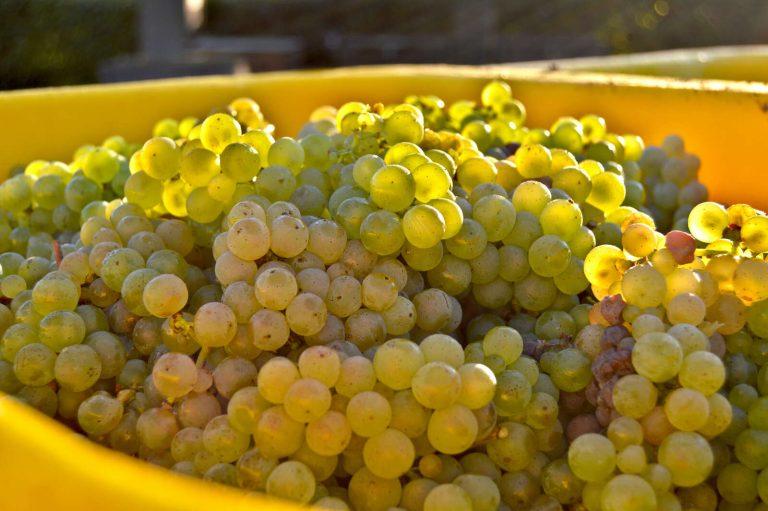
| Grape variety | Proportion in the blend |
|---|---|
| Gewurztraminer | 60 à 80 % (minimum requirement) |
| Riesling | 10 à 40 % |
| Pinot Gris | Maximum 30 % |
| Muscat | Maximum 10 % |
The Wines of Kaefferkopf
Gewurztraminer, the king of the hillside
This variety accounts for more than half of the vineyard, and it is often the one people instinctively associate with Kaefferkopf. On the nose, it reveals its characteristic aromas of rose, lychee, mango, sweet spices, and bergamot zest. On the palate, the texture is full-bodied, almost enveloping, yet with an underlying freshness that avoids the pitfall of a Gewürztraminer that is too heavy or too sweet, as is sometimes found elsewhere. Its finish is silky and long, with acidity that gives it structure.
It can be enjoyed young, but a few years of cellaring does it good. Sunny vintages yield almost opulent wines; cooler years produce Gewurztraminers that are more taut and straightforward, which age particularly well.
Riesling, the most serious one!
The Kaefferkopf Riesling is a wine with excellent aging potential. When young, it is understated: a nose of white flowers, fresh on the palate, almost austere. It needs time to develop. On granite soils, it develops an electrifying tension and a stony minerality that clearly sets it apart from the rounder Rieslings produced on limestone. Allow 5 to 10 years for it to truly begin to express itself.
Pinot Gris, the most approachable
More approachable than Riesling, more understated than Gewürztraminer, the Kaefferkopf Pinot Gris plays on its creaminess and fruitiness. Notes of white-fleshed fruits, marmalade, and fruit paste. On the palate, it’s straightforward and direct, with lovely freshness despite its roundness. It’s often the first wine we open, and the one we finish without even realizing it!
Blends: The True Expression of the Terroir
The Kaefferkopf blends are the wines that most surprise wine lovers who haven’t tried them yet. One might expect something heavy and sweet, but instead finds a taut, complex wine that ages well. The Gewürztraminer contributes aromas of rose and lychee, while the Riesling adds freshness and citrus notes. The result is rarely predictable, and always a pleasant surprise!
Food and Wine Pairings with the Kaefferkopf Grand Cru
Kaefferkopf wines aren’t aperitif wines, or at least, not exclusively. They have enough structure to pair with elaborate dishes, and enough character to hold their own against spices or rich sauces.
| Wine | Recommanded pairings |
|---|---|
| Gewurztraminer Kaefferkopf | Foie gras, Munster cheese, spicy dishes, chicken curry, desserts that aren't too sweet |
| Riesling Kaefferkopf | Cooked fish and shellfish, Alsatian baeckaoffa, seafood sauerkraut |
| Pinot Gris Kaefferkopf | Sweet-and-salty duck breast, goose foie gras, Bresse chicken |
| Assemblage Kaefferkopf | International cuisine, tagines, foie gras ravioli, dishes featuring exotic fruits |
A pairing you absolutely must try: Munster cheese and Kaefferkopf Gewürztraminer. Two bold flavors, two Alsatian products at their most intense: they balance each other out perfectly and create one of the most memorable pairings in regional cuisine.
How can I visit the Kaefferkopf vineyard?
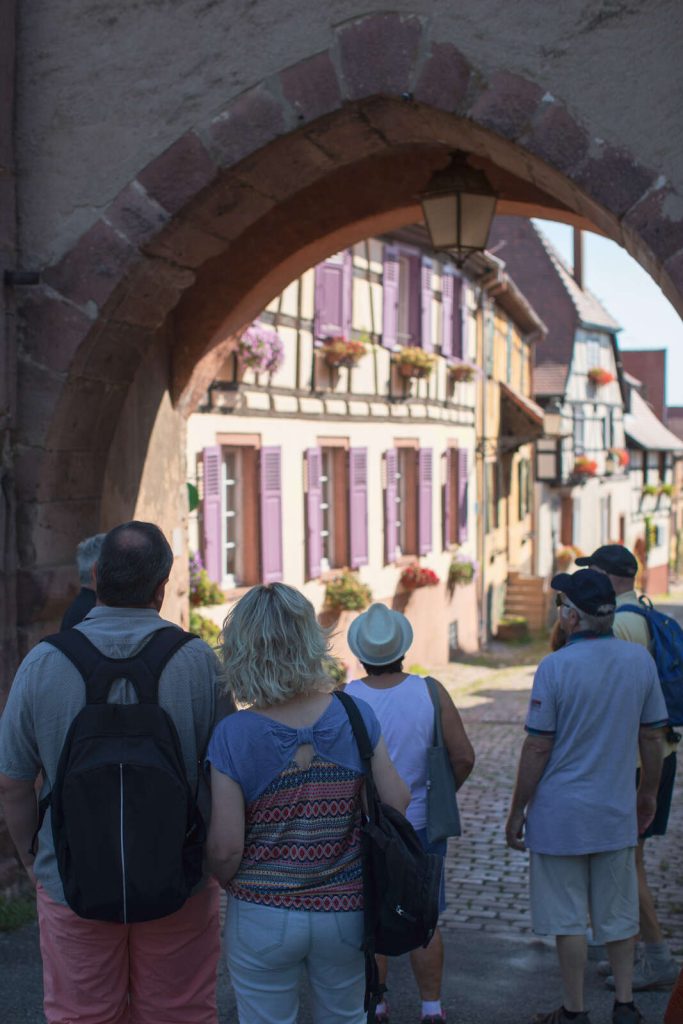
Visiting the Kaefferkopf means, first and foremost, strolling through the narrow streets of Ammerschwihr, a village that was almost entirely destroyed in 1944 and rebuilt stone by stone, and whose unassuming appearance belies a concentration of remarkable winemakers. Take the time to step inside the wineries.
Ask questions about the vineyard plots, the vintages, and the blending choices. The winemakers of Kaefferkopf generally have a lot to say, and they don’t all express themselves in the same way. Perhaps that, ultimately, is what makes this Grand Cru so rich: not a single, uniform identity, but a multitude of voices speaking about the same place.
The vineyard is accessible on foot from the village.
Marked trails let you walk along the vineyard plots, read the informational signs about the geology, and understand why one plot produces a crisp Riesling and another an opulent Gewürztraminer. A one-hour walk is enough to get a good sense of the terroir; allow half a day if you stop by the wineries.
The village is 5 km from Colmar and 2 km from Kaysersberg. It’s ideal for a bike ride, with a lunch stop at one of the village restaurants that showcase local wines (for example: Restaurant Amsel, Restaurant Le Valtrivin).
Key Figures
- The 51st and final Grand Cru of Alsace: officially classified in 2007, following an initial legal demarcation in 1932
- 71.65 hectares demarcated, including 44 hectares in production, spread across more than 600 parcels
- More than 100 winemakers cultivate the Kaefferkopf, each with their own interpretation of the terroir
- 55% Gewürztraminer (the dominant grape variety), followed by Riesling (30%) and Pinot Gris (9%)
- 1,328: first historical mention in the land registry of Pairis Abbey
Discovering Kaefferkopf means understanding that not all Grands Crus are alike. Here, richness is measured not only by the reputation of a name, but by the diversity of expressions offered by a single terroir.
As the seasons change, the hillsides of Ammerschwihr reveal a mosaic of landscapes, soils, and expertise that come together in every glass. Whether you’re a seasoned wine lover or simply a curious traveler passing through the Alsace Wine Route, Kaefferkopf invites you to take your time: to stroll through the vineyards, meet the winemakers, and, of course, enjoy a tasting.
For it is often in this way that the most wonderful discoveries are made: far from the obvious, in a place that doesn’t seek to impress but leaves a lasting memory long after your visit.